No Forwarding Address: How to Launch a New Website Without Losing Your SEO
A case study on the strategic growth of JAM Hospitality Group
You have spent a year on this site. You argued about font colors, you picked the hero image four times, and you rewrote the venue copy until it finally sounded like the business you actually run. It is beautiful. And on the morning it goes live, the only thing you are going to care about is whether the phone keeps ringing.
That is the real question underneath every redesign, and almost nobody says it out loud until the week of launch. Does the couple who was going to find us next Tuesday still find us next Tuesday?
Here is the answer I give every client who asks me. A new website never costs you your rankings. Moving without a forwarding address does.
A launch is a move. You are taking ten years of accumulated trust out of one building and carrying it into another one, and everything that goes wrong in a move goes wrong for the same reason: somebody showed up at the old address, and nobody told them where you went.
The high stakes at JAM Hospitality Group
JAM Hospitality Group is one of the largest catering companies in the Northeast, and they manage 17 venues. That is the part people miss. They are not only a caterer. They do the marketing for historic landmarks and high-volume event spaces, which means that when jamcater.com moves, the bookings for nearly twenty separate properties move with it.
A quiet quarter for JAM is not a bad quarter for JAM. It is a bad quarter for every venue on that list, and for the people who work in them.
They did not hire me to design the site. They hired me to make sure the move did not cost them anything.
It did not. Clicks from Google went up 57.8% year over year.
Here is exactly how we did it.
1. Working inside a design I did not draw
In the version of this story where everything is ideal, the SEO work starts before the first pixel. In the real world, a business falls in love with a design an outside agency already built, and by the time I am in the room, the architecture is settled.
JAM had a vision for the new site and another party had designed it. So my job was to work inside a framework I did not build, respect the design decisions the client had already made and paid for, and find the room to put the search work in anyway.
You do not need a technically perfect site to grow. You need somebody who knows how to optimize the site you actually have.
2. The forwarding address (301 redirects)
Every page on your current site has an address, and over the years Google has learned all of them. Pinterest has some of them saved. So do the couples who bookmarked a venue page in 2021, the local blog that linked to your catering menu, and the vendor who put you on a preferred list four years ago.
When you launch a new site, those addresses stop existing. Anyone who arrives at one finds a dead end, and after enough dead ends, Google concludes there is nothing there and gives the ranking to somebody else.
So before launch we built a redirect map. Every single link on the old jamcater.com was paired by hand with the page on the new site that replaced it. When someone clicks a five-year-old Pinterest link for Aldie Mansion weddings, she automatically lands on the new Aldie Mansion page, and she never sees that anything moved.
Google saw the same thing she did. The address changed, the business did not, and the authority came along with it.
Remember: a site can be moved. A reputation has to be forwarded.
3. Who answers when someone asks for the venue by name
In this industry, your most valuable searches are the ones where a couple already knows what she wants. She types Waterloo Village. She is not shopping. She is looking for you.
That is exactly the search the big directories fight hardest for, and when The Knot outranks you for your own venue name, you paid for the awareness and they collected the click.
So the Google Business Profiles got the same attention as the website itself. We sat with the JAM team and tutored them through optimizing profiles for more than 14 venues, including Bishop Farmstead and The Barn at Cauffiel, so that hours, phone numbers and addresses matched the new site everywhere, to the character.
Now when a couple searches a venue by name, she lands on JAM’s page instead of on a directory that will show her three competitors before she finds the one she was looking for.
4. The name on the new door
Google does not read your website the way a person does. It reads the labels. Your meta title is the blue headline in the results and your meta description is the paragraph underneath it, and on most sites those labels say things like Home and Services.
Nobody chooses a caterer off a link that says Services.
So we rewrote them as what they actually are, which is the first sentence of your sales pitch. A page that used to be labeled “Catering Menu” now reads “Philadelphia’s Best Wedding Catering & Seasonal Menus | JAM Hospitality.”
That does two jobs at once. It tells Google what the page is, and it gives the couple a reason to click this result instead of the one above it.
5. What we left at the curb
Ten years in one building leaves you with things you do not want to pack. Broken links to pages that stopped existing. Spam sites that linked to you without asking. Images sitting on the server at four times the size they need to be, with no description attached.
Carry all of that into the new site, and the problem moves in with you.
So we cleaned before we moved. We rewrote alt text so Google knows what is actually in the photographs, and we disavowed the toxic links, which is a formal way of telling Google to ignore the junk sites that had linked to JAM over the previous decade.
The site that arrived at the new address was lighter and faster than the one that left the old one.
6. The nameplate on every venue
Schema markup is a block of code your visitors never see. It sits in the page and tells Google, in a format built for machines rather than for people, exactly what this business is, where it sits, what it does, and what people have said about it.
Most sites that use it at all use it once, for the parent brand. JAM manages 17 venues, and a couple searching for one of them does not care about the parent brand.
So we wrote it for every managed venue in the portfolio. This page is a wedding venue. It is at these coordinates. These are its reviews.
That is how a JAM venue earns the star ratings and event details in a search result, and how it comes back looking like the official source instead of one more line on a directory.
7. Which rooms the public walks into
Not every page belongs to Google. Client portals, internal logins, thank-you pages after a form: those exist for people you already have, and every minute Google spends reading them is a minute it did not spend on the pages that bring you weddings.
So we audited what was indexed and drew the line. The client login pages for venues like the American Swedish Historical Museum and Bellevue Hall are marked private, and the marketing pages get the attention.
When a couple searches for one of those venues, she gets the photographs and the copy that were written to win her, and not a login box.
8. Handing Google the new address, and watching the first week
A sitemap is what it sounds like. It is the list of where every page on your site now lives, and Google reads it to find its way around. If it is stale or messy on launch day, Google spends the first weeks guessing, and guessing costs you rankings you already earned.
So we used Yoast to tune the site’s internal settings, prioritized the venue and menu pages in the sitemap, and resubmitted it to Google the moment the new site went live. No guessing.
Then we watched. Google Search Console is the direct line between your website and Google, and it is where Google tells you it is having trouble with something. We monitored JAM’s daily through the launch. When Google had a problem reading a page for Fonthill Castle or The Lake House Inn, we fixed it that day.
Most businesses find out something broke by noticing the traffic is already gone. By then, you have lost the leads, and you have no way to count them.
9. What actually happened
Most companies call a launch a success if traffic simply comes back to where it was. JAM did better than that.
- Clicks from Google: up 57.8% year over year.
- Venue keywords on page one of Google: from 16 to 61.
- Catering keywords on page one: from 29 to 58.
- The part I like most: JAM began outranking the national directories for searches on their own venues.
That last one is the whole point. The couple looking for Waterloo Village now finds Waterloo Village.
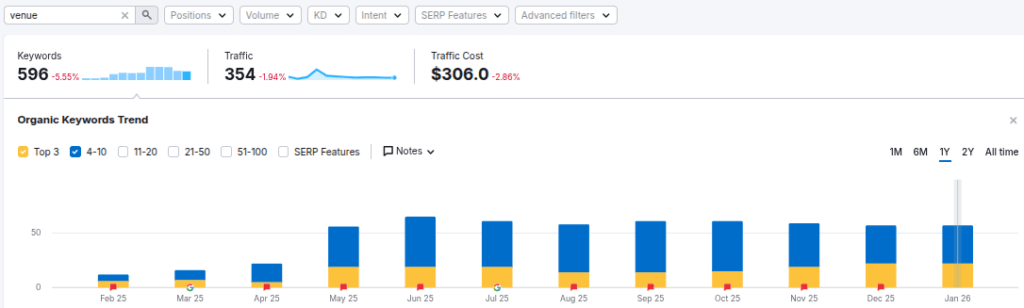
“Venue” keyword rankings for jamcater.com before and after website relaunch April 2025 ON PAGE ONE of Google.
Hire the mover before you pack
A designer is responsible for how the site looks. Somebody has to be responsible for what it earns.
If a redesign is on your calendar, the expensive version of this is finding out afterward. Rankings do not come back on their own, and the couples who could not find you during those months do not come back either, because they booked somebody else and they were happy about it.
With 50 years of combined expertise in SEO, AI, and wedding industry marketing, my team and I do the part a general agency misses: the schema that tells Google you are a local business, the redirect map that carries your history across, the heatmapping that shows where a couple gives up on your contact form.
Whether you want help:
- Launching a new site with the safeguards in place
- Improving the site you already have
- Getting found in Google and in AI search
Let’s start with a meeting, and I will bring a report on where your SEO stands right now.