The Wedding Vendor’s Guide to AI Search Visibility
Brian Lawrence Web Design & SEO helps wedding vendors appear in ChatGPT, Perplexity and Google AI Overviews by building the brand authority, plain-language content and citation footprint that AI systems use to identify a trustworthy local business. Everything in this guide comes out of real experiments with wedding-industry clients who now appear in AI-generated recommendations for searches like “best wedding DJs in Portland Maine” and “best wedding DJs in Cincinnati.”
Somewhere tonight a couple is sitting on a couch, eight months out from a wedding, and one of them is typing a question into ChatGPT. Not two or three keywords the way you would have typed into Google ten years ago. A whole question, in a full sentence, the way you would ask a friend who knows everybody in town.
And they are getting back an answer that names four businesses.
If yours is one of the four, you are having a conversation next week. If it is not, you never find out the conversation happened. That is the part of this nobody warns you about. There is no ranking to look up and no drop to notice. There is a couple who booked somebody else, and a quiet Tuesday you cannot explain.
Here is what I have learned running these searches over and over for my own clients, and it is the whole guide in one sentence. AI does not read your website to decide about you. It reads everyone else.
So think about how a recommendation actually works between two people. When you ask a friend who knows everybody for a wedding DJ, she does not open his website and read it to you. She tells you what she has heard. From the couples she knows. From the planner she trusts. From the venue that has worked with him nine times and would work with him again. And she only brings up the people she can describe in one sentence, because those are the ones she is sure about.
That friend is what you are dealing with now. Everything in this guide is about giving her something to say about you.
One promise before we start. This subject is full of words that were invented by engineers and never translated for the rest of us. Semantic. Schema. Entity. Structured data. I am going to define every one of them in plain English the first time it shows up, and then use it normally after that. If I use a word in this guide and do not stop and tell you what it means, I have not done my job. You should not have to be technical to run a wedding business in 2026.
How AI search is different for wedding vendors
For about twenty years, getting found online meant ranking on Google. You built a website, you put the right words on it, you got some other sites to link to you, and then you watched where you sat on a page of ten blue links. If you were number one, you got the click. Everybody understood the rules, including the couples playing by them.
Now she asks “who are the best wedding photographers in Austin,” and she is not shown a list at all. She is shown a written answer, in paragraphs, that names specific businesses and says why each one is worth her time. She may never visit your website. She may never see a page of search results in the first place.
And here is the part that takes a minute to sink in. The decision about which businesses go into that answer was made long before she asked the question.
These systems are built by reading enormous amounts of what is written on the internet. That reading is called training data, which is just a technical way of saying everything the system read while it was being built. Out of all that reading, it forms a working sense of which businesses are trusted, well reviewed, mentioned often, and described the same way in a lot of different places. When the question finally gets typed at 9:40 on a Tuesday night, that stored sense is what answers it.
Which means your visibility in AI search is not set on your website. It is set by the weight of everything the internet already says about you.
Remember: what you say about your business is a claim. What everyone else says about your business is the evidence.
That is not me being clever. That is the actual mechanism, and once you see it, every recommendation in this guide stops sounding like a chore and starts sounding obvious.
Google AI Overviews vs. ChatGPT vs. Perplexity: what is different
There are three places this is happening, and they do not work the same way, which changes where you spend your effort.
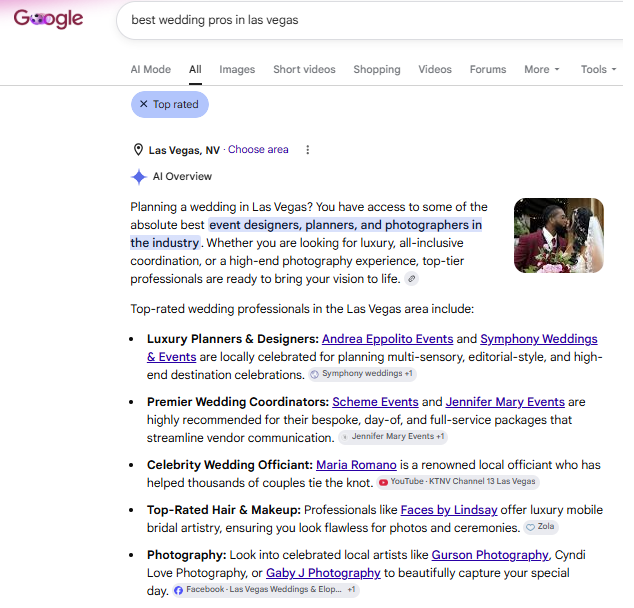
Sample search in Google AI Overview answer for the best wedding pros in Las Vegas
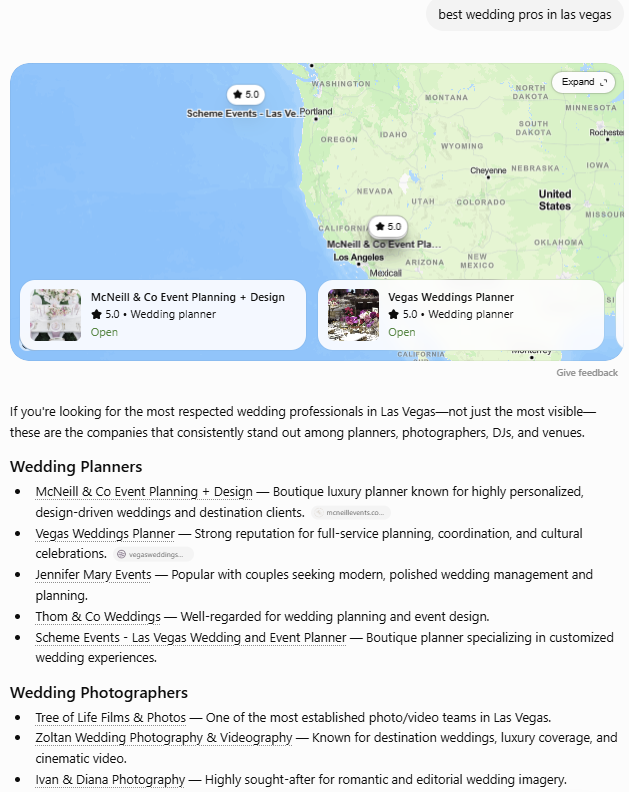
Sample search in ChatGPT for the best wedding pros in Las Vegas
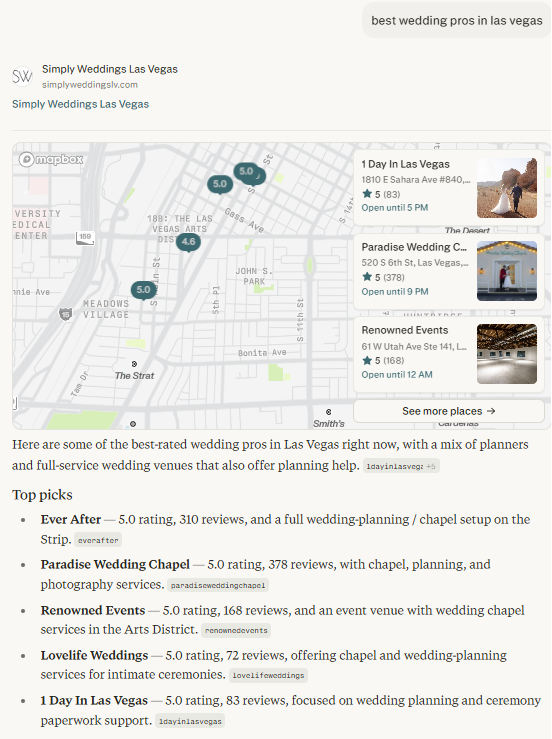
Sample search in Perplexity for the best wedding pros in Las Vegas
Google AI Overviews. An AI Overview is the written answer that now sits at the very top of a Google results page, above the blue links. It is Google answering the question itself instead of only pointing at other people’s pages. It builds that answer out of pages Google has already indexed, which means visited, read, and filed away. So your website, your Google Business Profile, your hours, your photos, and the code inside your pages all feed it directly. Of the three, Google gives you the shortest distance between the work you do and the visibility you get.
ChatGPT. ChatGPT answers mostly from its training data, and in the versions that can browse, from a live search it runs at that moment. What it responds to most is recognition: whether your business name shows up in the same exact form in a lot of different places, how deep your reviews go, and whether anybody other than you has written about you. A business that turns up on The Knot, on WeddingWire, on a local wedding blog and in a news story is much likelier to be named than a business that exists only on its own website.
Perplexity. Perplexity works closest to a live search engine with an AI layer sitting on top. It goes out and reads pages in the moment, and it shows you its sources right there in the answer. So the way in is to be named on the outside sources it is already reading: best-of lists, industry publications, local directories.
Now the good news, and it is genuinely good news. The work overlaps almost completely. Three things count on all three:
- A website that says plainly what you are and where you work.
- Your business named consistently in places you do not own.
- Detailed reviews on more than one platform.
Everything below is one of those three, in more detail.
What we found when we searched ChatGPT for wedding DJs
“When I searched ChatGPT for wedding DJs in Maine and Cincinnati, here is what came back, and why.“
We run this experiment regularly across our clients. The goal is never to find a permanent ranking, because these answers are not fixed and they change from week to week. Anybody promising you a permanent spot in ChatGPT is selling you something. What I want to know is narrower and more useful: when I run the same question, in the same city, over and over, which businesses keep showing up, and what do those businesses have in common.
What came back was repeatable.
Two of my wedding DJ clients, Big Daddy Walker Productions in Cincinnati and The Music Man DJ Service in Maine, appeared on their own in ChatGPT’s recommendations for wedding DJs in their markets. Neither paid for placement. Neither had a viral moment. Both showed up because of what was already sitting underneath them.
Here is what the two had in common:
- The same business name, address, and phone number everywhere they are listed
- Real Google review volume, and reviews with enough detail to name the actual service
- Complete profiles and review history on The Knot and WeddingWire
- The fact sheet code on their websites filled in and checked (I explain exactly what that is further down)
- Service pages that open with a plain sentence saying who the business is, what it does and where it works
- Their names mentioned on other people’s websites: wedding blogs, best-of lists, vendor roundups
The businesses that did not show up shared a different pattern. Directory listings half-filled in. A business name that changed shape from one platform to the next. Website copy describing the service in words that could describe anybody in the category. And nothing written about them anywhere except by them.
I want to be careful here, because this is the part that stings. None of that is a judgment about the quality of their work. Some of those businesses are excellent, and I would hire a few of them myself. It is a judgment about evidence. These systems do not guess at who is good. They read what is in front of them, and if there is not much in front of them, they move on to a business where there is.
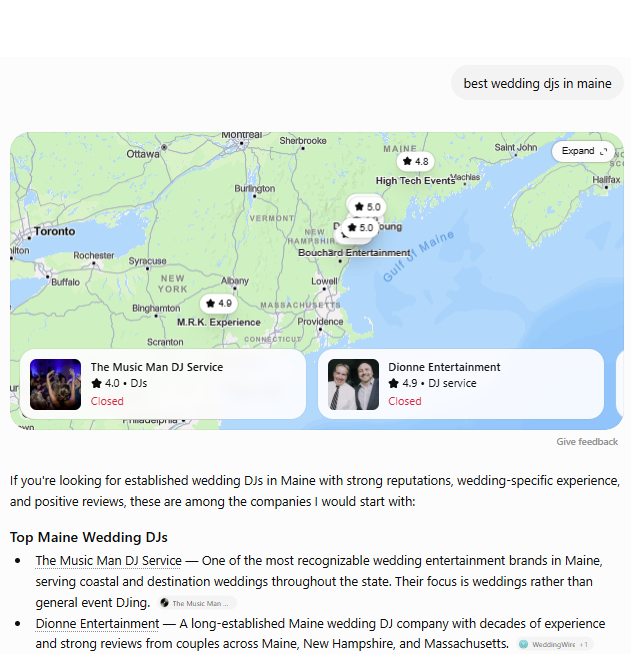
Sample search in ChatGPT for best wedding djs in maine
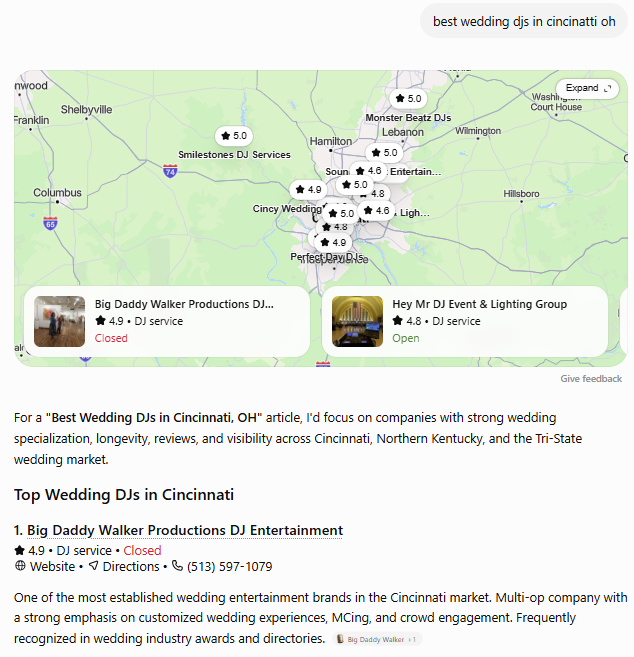
Sample search in ChatGPT for best wedding djs in cincinatti oh
The 6 signals AI uses to recommend a wedding vendor
A signal, in this business, means anything a machine can read and count as evidence about you. Here are the six that decide whether a wedding business turns up in an AI answer.
1. Your name, exactly the same everywhere. These systems judge how widely and how consistently a business is known, and the measure is whether the same name shows up in the same form on Google, on The Knot, on WeddingWire, on Facebook, on Yelp, and everywhere else you are listed. “Big Daddy Walker” in one place and “Big Daddy Walker Productions” in another reads as two different companies, and whatever credibility you built gets split between them. Same name everywhere and it stacks instead.
This is the least glamorous item on the list, and it is the one I fix first, every time.
2. Reviews in more than one place, with actual words in them. Google reviews are necessary and they are no longer enough on their own. These systems pull review content from several platforms at once, so a DJ with 120 reviews on Google, 40 on The Knot and 30 on WeddingWire gives a much fuller picture than a DJ with 200 on Google and nothing anywhere else.
And what is inside the review counts as much as the number of them. A review that names what you did, where the wedding was, and what stood out gives the answer an actual sentence to repeat about you. A five-star rating with no words gives it nothing.
3. Other people mentioning you. A citation, here, means somebody else’s website naming your business. It does not have to be a link. A mention counts. That is different from a backlink, which is a link from their site to yours, and which is what our industry spent twenty years chasing. Both are useful, and for AI visibility, the plain mention does more work than people expect.
Being named in a “Best Wedding DJs in Ohio” roundup on a real local blog does more for you than five more pages on your own website. You cannot be your own source. Somebody else has to say it.
4. The fact sheet in your website’s code. This one has an ugly name, so let me define it carefully, because it comes up constantly and almost nobody explains it.
Schema markup, also called structured data (two names for the same thing), is a short block of code that sits inside your website where no visitor ever sees it. Think of it as a fact sheet written for machines. Your web pages tell a human being who you are through photographs, headlines and paragraphs. The fact sheet says the same things in a form a machine cannot misread: this business is called this, it is this kind of business, it is at this address, these are its hours, these are the services, these are the questions it answers.
Without it, a machine has to work all of that out from your prose and hope it got it right. With it, there is nothing left to work out.
5. Sentences a machine can repeat. These systems scan a page looking for a direct answer, and the clearest thing you can hand them is what our industry calls a semantic triple. Ignore the name for a second. Semantic just means “having to do with meaning,” so a semantic triple is a sentence built out of three plain parts: who you are, what you do, and where you do it.
Like this: “The Music Man DJ Service is a wedding DJ and entertainment company serving Kennebunkport, Portland and York, Maine, as well as Portsmouth and the Seacoast region of New Hampshire.”
One sentence, and the name, the category and the service area are all settled. Compare that with “we have been serving couples for over 20 years,” which is warm, true, and tells a machine nothing it can use. It will go find a clearer source instead.
6. The same details everywhere, not just the same name. Entity is the industry word for your digital identity: your name, address, phone number, website and category, taken together as one bundle. That bundle is you, as far as a machine is concerned. When it matches everywhere you appear, the picture of you gets sharper every single time the system runs into you. When it does not, an old address here, a tracking phone number there, the picture blurs and keeps blurring.
Audit your listings on a schedule and fix what does not match, before it multiplies.
Action steps for your own website
Your website is still the founding document. Nothing can recommend a business it cannot describe, and your website is where the description starts.
Write your opening sentences so a machine can repeat them
Every important page should carry one of those three-part sentences in its first paragraph. The shape is: your business name, then what it does, then specifically where.
For wedding vendors:
- [Business Name] is a luxury wedding DJ serving Philadelphia, the Main Line and South Jersey.
- [Business Name] provides full-service wedding photography for couples at venues across Austin and the Texas Hill Country.
- [Business Name] is a wedding venue in Chester County, Pennsylvania, accommodating up to 250 guests for ceremonies and receptions.
- [Business Name] has been providing wedding planning services in the Nashville area since 2009.
Then do the edit that feels strangest and returns the most. Go back through those core sentences and replace every “we” and “our” with your actual business name.
I know. It reads oddly at first, and every writing teacher you ever had would flag it. Here is why it works anyway. You and I read “we” and know exactly who “we” is, because we read the sentence before it. A machine cannot always carry that over. Every “we” is one more place it has to guess, and a system with a hundred businesses to choose from does not guess, it moves on to the one that spelled it out.
Here is the same venue handled page by page:
- Homepage or about page: “Experience Oakhaven is a luxury destination wedding venue in the Piedmont region of North Carolina, hosting multi-day wedding weekends for 100 to 150 guests.”
- Accommodations page: “Experience Oakhaven provides on-site lodging for wedding weekend guests in the English Manor House, the Honeymoon Cottage, Woodrow’s Cabin and The Bungalow.”
- History page: “Experience Oakhaven has operated as a wedding and event venue since January 2006, on a family estate dating to 1930.”
Every one of them opens with the name instead of a pronoun, says the category out loud, and pins down the geography. Write your first paragraph that way and let the rest of the page sound like you.
Put the answer first
These systems pull from content near the top of a page that sits close to the question that was asked. The common mistake, and I see it on beautiful websites every week, is burying the answer in the third or fourth paragraph, behind an introduction about how weddings are the most important day of a couple’s life and how passionate your team is about capturing memories.
Put the answer in the first paragraph. If the page is about wedding DJ services in Maine, that first paragraph says you are a wedding DJ working in Maine, what your specialty is, and what is different about the way you do it.
The emotional writing still belongs on the page. It is what makes a couple choose you over someone with the same list of services. It just belongs second. She will read all of it. The machine reads the top.
Build FAQ pages that match how couples actually ask
FAQ content is your most direct route into a Google AI Overview, because when your answer matches the shape of a real question, it can be pulled straight into a response.
The difference between an FAQ written for old-school search and one written for AI search is the question, not the answer. Traditional SEO pushed you toward stubby keyword phrasing: “Wedding DJ Maine cost.” AI search rewards the way a person actually talks: “How much does a wedding DJ cost in Maine?”
Write every question the way a couple would say it out loud in your kitchen.
Topics yours should cover:
- What does a wedding DJ cost in [your market]?
- How far in advance should I book a wedding DJ?
- What areas do you serve?
- What does your setup look like at the venue?
- How do you handle song requests?
- What happens if there is a technical problem on the day?
- Can we meet before we book?
- What is included in your pricing?
Then have your developer add the FAQ version of that fact sheet code to every page with questions on it. Without it, your answers might still get read. With it, they are labeled as questions and answers, and they are ready to be used.
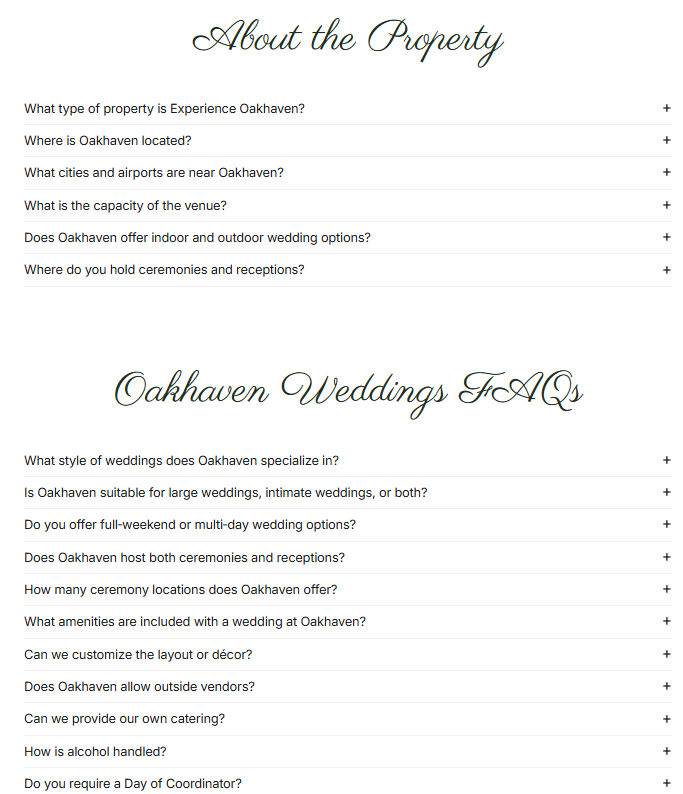
Sample of Experience Oakhaven FAQ page.
Get the fact sheet code onto your site
This is the one to hand your web person, so here it is in their language and yours side by side. Four pieces:
- LocalBusiness, with the right subtype. Subtype only means the more specific category underneath “business,” the way “DJ” is more specific than “vendor.” EntertainmentBusiness for a DJ,
- EventVenue for a venue, PhotographyBusiness for a photographer.
- FAQPage, on any page with questions and answers on it.
- Service, on each individual service page, with that page naming the actual cities and counties you cover.
- Person, for you or whoever leads the business, connected to the company. This is how a machine learns that you are a real named professional and not a logo.
All of it should sit together in one block of code on the site. Your developer will call that block JSON-LD, which is simply the format the fact sheet gets written in. You never have to touch it or understand it.
Then check the work. Google’s Rich Results Test and the Schema.org validator are two free web pages where you paste in your web address and they tell you whether the fact sheet is written correctly. Both are free, both take a minute.
One piece of housekeeping while somebody is in there. If your site has old code that puts your own star ratings into search results, take it out. Google deprecated that for local businesses in 2023, and deprecated means retired: they stopped supporting it, so it no longer does the thing it was put there to do.
Action steps away from your website
Your website is one voice, and it is the one voice with an obvious interest in the answer. Everything in this section is about the other voices.
Get reviews in more than one place
Most wedding businesses have put every ounce of review effort into Google for a decade, and that was the right call at the time. Google reviews are still the single most important source. But the answer a couple gets is assembled from several platforms at once, and a business with reviews spread across a few of them gives it much more to work with.
Where to collect, in order:
- Google Business Profile. Your Google Business Profile is the box with your map pin, hours, photos and reviews that shows on the right side of Google, or at the top of the screen on a phone. It used to be called Google My Business. It is still the most important single source.
- The Knot and WeddingWire. The two review platforms built for this industry.
- Yelp. Widely read by these systems.
- Better Business Bureau. A credibility marker.
- Facebook. Social proof that feeds the recognition signal.
And ask for the right kind of review. “Great DJ, would recommend!” gives a machine nothing to repeat about you. A review naming the service, the venue and what actually happened gives it a sentence.
So put the ask in your request. When you send the review link, add one line: could you mention what we helped you with, how the day went, and what stood out for you. Couples are happy to do it. Nobody has ever told them what was useful.
Get other people to mention you
The highest-value work off your own site is getting named on the sources these systems are already reading in your market. And you can find out exactly which sources those are, yourself, in about twenty minutes.
Run the searches. Open ChatGPT and Perplexity and ask for “best wedding DJs in [your city]” and “top wedding photographers in [your city].” Write down every source the answer names or links to. That list is your outreach plan, in priority order, built from real evidence instead of a guess.
What usually turns up for wedding vendors:
- Local wedding blogs and best-of roundups
- Regional lifestyle and event publications
- Directories beyond The Knot and WeddingWire: wedding associations, chambers of commerce, venue preferred-vendor lists
- Podcast and YouTube guest appearances in the wedding space
- Local news coverage of your business or your work at a notable event
- Press releases for real milestones: an anniversary, an award, a new service
Remember that a mention counts even with no link attached, because these systems read the writing, not only the links inside it. Being named in a credible article about the best wedding vendors in your city puts you into the conversation directly.
Show up in more than one place online
These systems read YouTube, Reddit, LinkedIn, industry forums and social platforms alongside ordinary websites. A business that exists only on its own site and its Google profile gives them very little to find. A business with a YouTube channel showing real weddings, a LinkedIn profile for the owner, a presence in The Knot’s community, and features in blog content turns up everywhere they look.
You do not need to be everywhere. Pick two or three places beyond your website where you can genuinely keep showing up, and make sure your business name appears in exactly the same form on every one of them.
How to keep your Google Business Profile current for AI
For Google AI Overviews specifically, your Google Business Profile is the most trusted single source there is. Google treats it as the official record on a local business, which means what your profile says about you carries further than what your own website says about you.
The profile work that counts most:
- Write the description as one of those three-part sentences. Name the business, what it does, where it works, and what is different about it, inside the first two sentences.
- List every service separately, each with its own description. That service list gets read directly.
- Update the photos. A thin or aging photo library reads as a business that has gone quiet.
- Answer every review, the good ones and the difficult ones. Responses are read as evidence that somebody is home.
- Watch the Q&A section and answer it. Anyone can post a question there. An unanswered one is a hole, and a hole gets filled from somewhere else, sometimes wrongly.
- Post at least twice a month. Activity tells Google the business is current.
None of that takes long. It takes remembering, which is why it belongs on a calendar and not in your head.
Your AI visibility checklist for wedding vendors
Work through this to see where you actually stand. Every line is one concrete thing with a direct effect on AI visibility.
Your website
- The first paragraph of every key service page names your business, says what it does, and says where
- The first paragraph answers the question directly, with no narrative windup in front of it
- FAQ content on the homepage and every service page, written the way a couple would say it out loud
- The FAQ fact sheet code added and checked on every page that has questions on it
- Every “we” and “our” in your core descriptive sentences replaced with your business name
- Your service area named specifically by city, county and neighborhood, not “the tri-state area”
- The code side (hand this section to your developer)
- LocalBusiness schema on the homepage with the correct subtype, in one block of code
- Service schema on individual service pages, each naming the cities and counties served
- Person schema for the owner or lead professional, connected to the business
- Everything checked through Google’s Rich Results Test
- Old retired schema removed, including self-hosted star-rating code
- Name, address and phone identical across your code, your Google Business Profile and every directory
Reviews
- Actively collecting on Google, The Knot, WeddingWire, Yelp, BBB and Facebook
- Your review request rewritten to ask for specifics
- Every review answered, good and bad, within five business days
Google Business Profile
- Description written as a three-part sentence in the first two lines
- Every service listed separately with a description
- Photos updated within the last 90 days
- Q&A section watched, every question answered
- Posts published at least twice a month
Your name out in the world
- Business name appearing in exactly the same form on every directory and platform
- Category searches run in ChatGPT and Perplexity to see which sources they name in your market
- Outreach started to the top sources on that list
- Listed in at least one local wedding best-of roundup or publication
- At least one YouTube or podcast guest appearance done
The words, in plain English
Keep this part. It is the vocabulary that gets used at you in meetings.
- AI Overview. The written answer at the top of a Google results page, above the blue links.
- Backlink. A link from someone else’s website to yours.
- Citation. Someone else’s website mentioning your business by name. No link required.
- Deprecated. Retired. Google stopped supporting it, so it no longer does anything.
- Entity. Your digital identity as one bundle: name, address, phone, website, category.
- Indexed. Google has visited a page, read it, and filed it.
- JSON-LD. The format the machine-readable fact sheet is written in. Your developer’s problem, not yours.
- NAP. Name, address, phone. Our shorthand for the three details that have to match everywhere.
- Schema markup, or structured data. A hidden block of code on your site that states your business facts in a form built for machines.
- Semantic. Having to do with meaning. When somebody says a page needs to be more semantic, they mean it needs to say what it means plainly enough that a machine does not have to guess.
- Semantic triple. A sentence in three parts: who you are, what you do, where you do it.
- Signal. Anything a machine can read and count as evidence about your business.
- Training data. Everything an AI system read while it was being built.
Work with Brian Lawrence on AI search visibility
I have been building websites and SEO strategies for wedding professionals since 2008. The move to AI search is the biggest change in how couples find vendors since The Knot showed up, and the strange part, once you get past the vocabulary, is how familiar the actual work turns out to be. It rewards credibility, clarity and consistency. That is what has always worked in this industry, and it is what works with a machine reading about you at midnight.
My team and I work with wedding DJs, venues, photographers, planners and entertainment companies to build the authority and the technical foundation these systems read. Clients of mine turn up on their own in ChatGPT results for competitive searches in their cities. There is no shortcut in any of it. It is the steps in this guide, done in order and kept current.
If you want to know where you stand today, start with a free consultation. I will look at your current AI visibility, show you the specific gaps, and tell you plainly what has to change.